Concept / R&D / Drones / AI
Rescue Drones.
Drones for water rescue.
A concept for faster support.
An R&D direction exploring remotely operated rescue drones, inflatable flotation equipment and future AI-assisted monitoring of swimming areas.
- Project
- Rescue Drones
- Sector
- Water safety & emergency response
- Status
- Concept / R&D Direction
- Focus
- Remote operation & AI-assisted monitoring
Exploring faster emergency support through drones and AI.
Rescue Drones was developed as a Concept / R&D Direction exploring how unmanned aerial systems and artificial intelligence could support water safety and emergency response.
The initial application scenario focused on rescuing people in distress at sea and within designated swimming areas. The proposed system was designed to reduce the time between detecting an emergency and delivering initial flotation support.
The concept combined remote drone operation, emergency-response workflows, inflatable rescue equipment and a future AI-assisted monitoring system.
The concept explored how a remotely operated drone could quickly deliver flotation support while an AI system monitored designated swimming areas.
Initial application: water rescue
The first planned application was the rescue of people in distress at sea or within an approved swimming zone.
In the initial operating model, a trained operator would control the drone remotely. When an emergency situation was identified, the operator could direct the drone to the relevant location and release a compact rescue package.
The package was designed to activate and inflate after impact with the water. Once deployed, it would provide flotation support to the person in distress while professional rescue teams were being mobilised.
Proposed operating model
01 / DETECT
Identify a potential emergency
An operator or a planned AI-assisted monitoring system identifies a situation that may require emergency support.
02 / ASSESS
Evaluate the situation
The available visual information is reviewed to determine whether drone-based assistance may be appropriate.
03 / DISPATCH
Direct the drone
In the first version of the concept, a trained operator controls the drone and directs it towards the relevant area.
04 / DELIVER
Release flotation support
The drone releases an inflatable rescue package designed to activate after contact with the water.
AI-assisted monitoring direction
A later stage of the concept envisioned an AI-powered monitoring system capable of supporting patrol operations along an approved swimming zone.
The drone would patrol the designated area while collecting visual information from its surroundings. The AI system would analyse this information and look for signals that could indicate a potentially dangerous situation or a person in distress.
The purpose of the AI system would be to support detection and response, not to replace professional rescue services or human supervision.
Planned AI capabilities
Monitor a defined swimming area.
Analyse visual information collected by the drone.
Identify potentially dangerous situations.
Recognise signals that may indicate a person is in distress.
Notify the responsible operator.
Support a predefined emergency-response procedure.
Assist with the decision to dispatch the drone and release rescue equipment.
Human supervision and emergency response
Human supervision was a central part of the proposed operating model. In the first version, the drone would be controlled by a trained operator rather than operating independently.
The future AI component was intended to assist with monitoring, detection and prioritisation. Any action involving the deployment of rescue equipment would require a clearly defined safety process and appropriate human oversight.
The concept was therefore based on a human-in-the-loop approach, where automated analysis could support operators without replacing established rescue and emergency procedures.
Product direction
The concept was intended to combine several technology areas into one emergency-response workflow:
Remotely operated aerial systems.
AI-assisted visual monitoring.
Computer vision and signal recognition.
Designated-zone patrols.
Emergency alerts and operator workflows.
Rapid delivery of inflatable rescue equipment.
Integration with professional rescue procedures.
Technology direction
Rescue Drones was explored as a multidisciplinary R&D direction involving drone operations, AI, computer vision, communication systems and emergency-response design.
Specific drone models, sensors, AI models, communication protocols, deployment infrastructure and control systems were not fixed or disclosed as part of the concept.
Core platform
Unmanned aerial system
Control model
Remote operation by a trained operator
AI direction
Visual monitoring and emergency signal recognition
Response
Delivery of inflatable rescue equipment
Operating area
Approved swimming zones and coastal areas
Safety model
Human supervision and predefined procedures
Potential social and operational value
The concept explored how drones could provide rapid initial support in situations where every minute may be important.
Aerial systems could potentially reach a person in distress faster than a rescue team travelling from a distant location. The delivery of flotation equipment could provide temporary support while trained professionals continue the rescue operation.
AI-assisted monitoring could also help operators oversee larger designated areas and identify situations that may otherwise be difficult to detect from a fixed observation point.
Project status
Rescue Drones was developed as a Concept / R&D Direction. The project describes a proposed product scenario and technology direction rather than a deployed or certified rescue service.
The concept was intended to serve as a foundation for further research, prototyping, safety analysis and discussions with technology, maritime-safety and emergency-response partners.
Project visuals
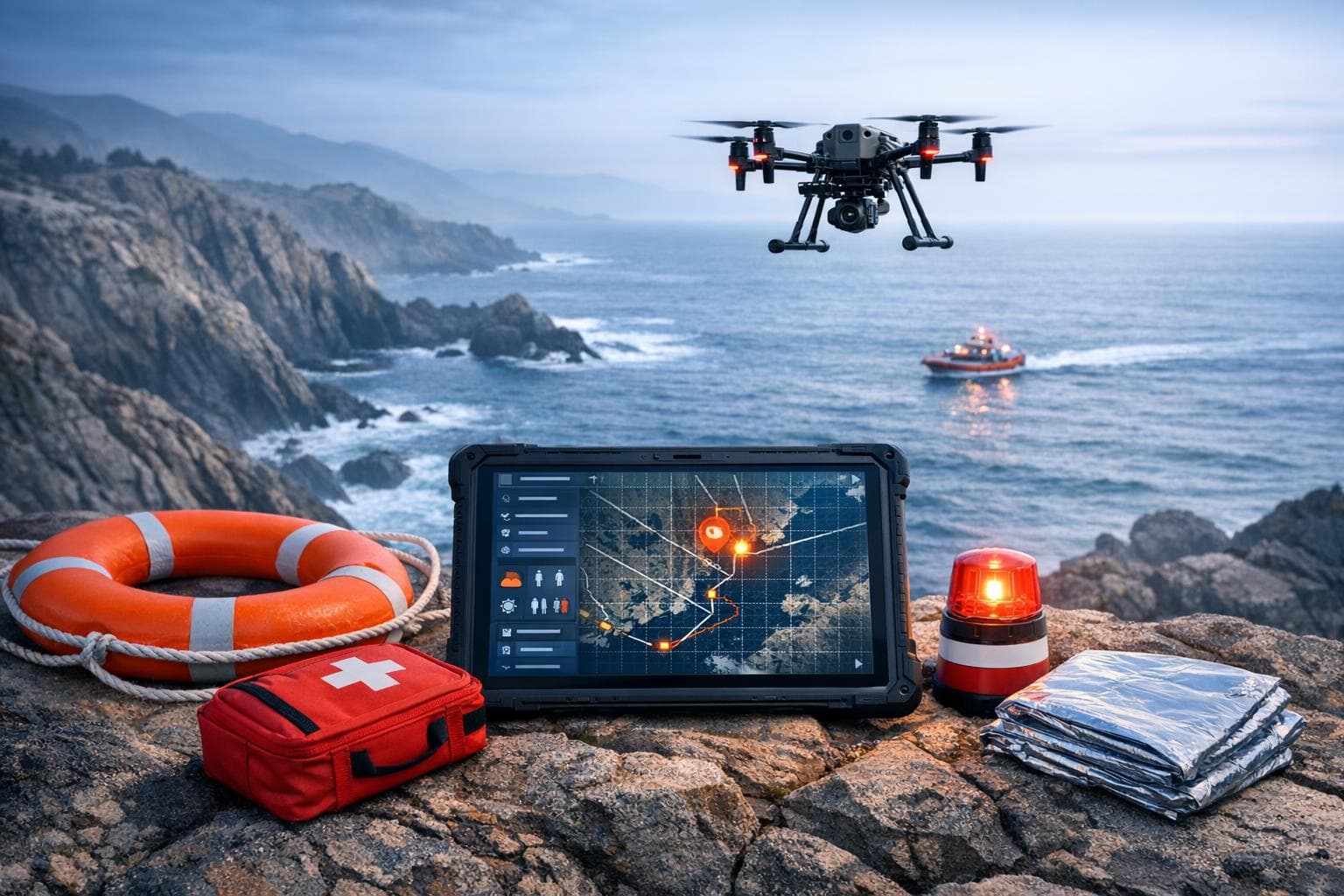
The visual on this page is a conceptual portfolio image representing drone-based emergency response, water rescue and AI-assisted monitoring.
It is not presented as a direct screenshot of a deployed product or certified rescue system.
Exploring a drone or AI concept?
Let’s shape your research direction, operator workflows and prototype requirements.