Business
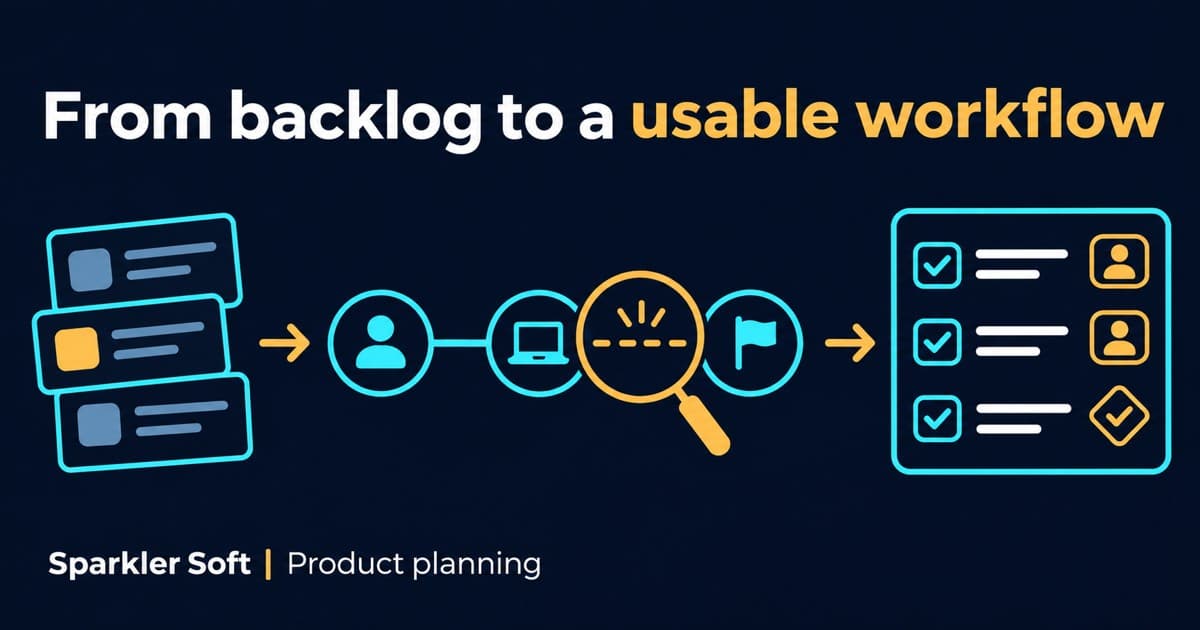
From backlog to a usable workflow
Walk through a complete user journey, inspect a failed integration and turn observations into requirements, owners and decisions before estimating development.
Sparkler Soft6 Nov 20263 min read
Blog
Current engineering notes on iOS, Android, web, ML, and DevOps, plus selected technology news from our 2021–2022 archive.
Walk through a complete user journey, inspect a failed integration and turn observations into requirements, owners and decisions before estimating development.
Plan a software project handover with a checklist covering code, access, builds, integrations, documentation, releases and ownership.
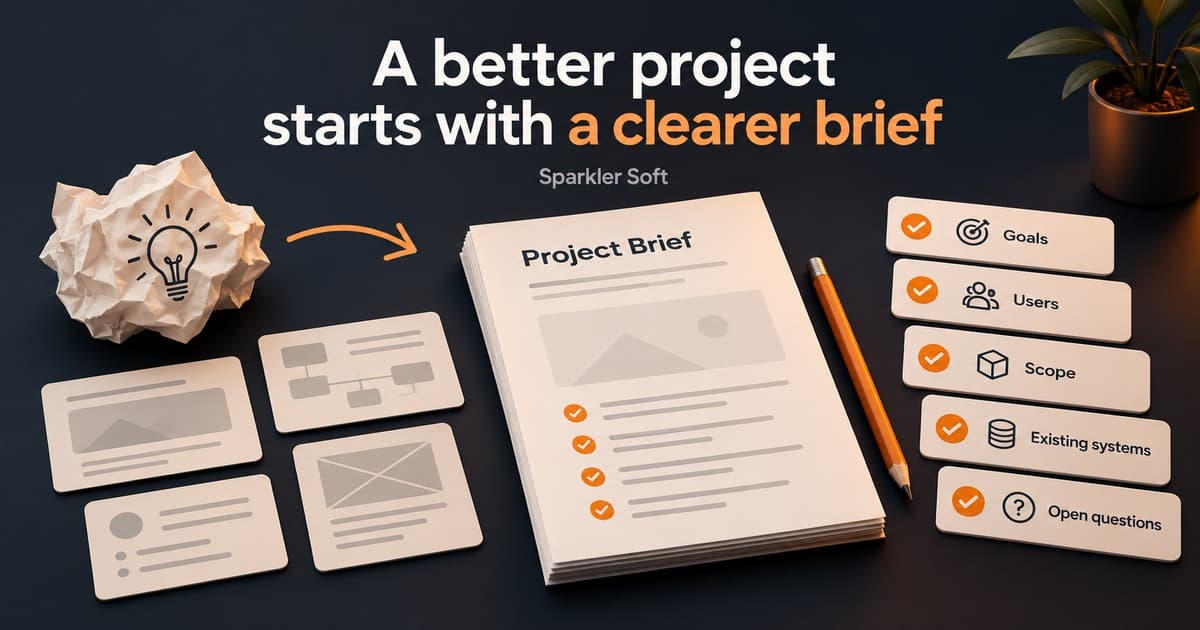
Prepare a useful project brief with clear goals, users, first-release priorities, constraints and open questions. Includes a practical checklist and a fictional example.
Check login, permissions, purchases, backend availability and review access, then use a practical workflow to investigate rejection feedback.
Compare native apps, shared logic and shared UI, then scope a representative feature to evaluate the approach for your product and team.
The right question isn't "which is better" — it's how many different clients need overlapping-but-different shapes of the same data.
Training/serving skew, silent data drift, and unowned retraining pipelines — the ordinary cost of running ML as a real product feature.
Right-sizing, targeted Spot usage, traffic-shaped autoscaling, and storage tiering — a practical cost review
The useful question isn't "build or buy" — it's which work benefits from deep institutional knowledge, and which is well-scoped and time-bound.
View updates, stable collection identity and the cost of creating views — three areas to investigate with profiling tools.
Environment drift, poorly-keyed caches, tests skipped under pressure, and no fast rollback path — checks to make before your next release.
The original November 2022 explainer introduced three terms often grouped together under artificial intelligence: narrow AI, general AI and superintelligence. They describe different levels of capability, rather than three interchangeable labels for the same technology.