Mobility / Transportation / Mobile
Taxi Service.
Book. Ride.
Stay connected.
A connected taxi platform with mobile applications, frontend and backend components delivered from scratch to completion.
Explore the product
- Client
- Taxi Service
- Sector
- Transportation & mobility
- Platforms
- iOS, Android & web
- Scope
- Full-cycle development
A connected digital platform for taxi operations.
Taxi Service is a mobile transportation project developed to support the interaction between passengers, drivers and the service operation. The product combines mobile applications with frontend and backend components required to support a connected taxi service environment.
The platform was designed around the practical needs of an on-demand transportation service: requesting a ride, coordinating vehicles, managing routes and keeping the customer informed during the journey.
The project included iOS and Android applications as well as the server-side and frontend components required to operate the broader digital service.
Taxi Service brings passengers, drivers, routes and operational data together in one connected mobility product.
Business context
Taxi and ride-hailing services depend on coordination between several participants. Passengers need a simple way to request transportation and follow the status of a ride. Drivers need information about requests, locations and routes. Service operators require a reliable digital foundation for managing the overall process.
A mobile taxi platform therefore involves more than a passenger application. It requires connected interfaces, backend services, location-related functionality and business logic for processing requests and coordinating the service.
Taxi Service was developed as a full product ecosystem rather than as an isolated mobile interface.
Product solution
The solution combines mobile applications for iOS and Android with frontend and backend development. This structure supports the interaction between customer-facing experiences, service operations and the underlying data and business logic.
The product was structured around the following principles:
Provide passengers with a convenient mobile taxi-booking experience.
Connect customer requests with available drivers and vehicles.
Support location-aware service workflows and route management.
Keep users informed about the status of a transportation request.
Create a technical foundation that can be extended with additional mobility features.
Key product areas
Passenger experience
The passenger-facing layer is designed to make the process of requesting transportation clear and accessible. A mobile experience can guide the user from defining a pickup location to following the progress of the ride.
Driver and vehicle coordination
A taxi service depends on the connection between ride requests and available vehicles. The platform supports the broader logic required to coordinate drivers, vehicles and customer requests.
Location and route management
Location-related functionality is an important part of a modern taxi service. Routes, pickup points, destinations and vehicle positions form the operational basis for coordinating transportation.
Service status and communication
Users need visibility into the current status of their request. Connected digital workflows can provide updates throughout the transportation process and help create a more predictable customer experience.
Connected mobility workflow
The central challenge of the project was to connect several stages of the taxi journey: the customer request, vehicle assignment, route coordination and completion of the ride.
Mobile applications provide the user-facing layer, while frontend and backend components support the service logic behind the experience. Together, these components create a platform capable of connecting customer activity with transportation operations.
This type of architecture can be adapted to different taxi, transportation and on-demand mobility business models.
Development scope
Sparkler Soft delivered the iOS, Android, frontend and backend components from scratch to completion.
The development scope covered the creation of the mobile product layers and the server-side functionality required to support a connected taxi service.
The full-cycle approach allowed the project to be developed as one integrated digital product, with attention to the relationship between mobile interfaces, backend services and operational workflows.
iOS mobile application development.
Android mobile application development.
Frontend development.
Backend and server-side business logic.
Connection between customer and service workflows.
Location-aware transportation functionality.
Technical preparation for future integrations.
Technology approach
The project was developed using technologies from Sparkler Soft’s native mobile, frontend, backend and cloud engineering stack. The exact project-level implementation details are not disclosed, while the general technology areas reflect the company’s development capabilities.
iOS
Swift and Objective-C
Android
Kotlin and Java
Backend
Java and Spring Boot
Frontend
React JS and Node JS
Location services
GPS, maps and route-related functionality
Cloud
Amazon Web Services
Architecture and integration potential
Taxi platforms commonly need to communicate with mapping services, payment providers, notification systems, analytics tools and operational platforms. A connected backend architecture provides the foundation for these integrations.
Sparkler Soft develops custom APIs and mobile SDKs and can integrate third-party services through APIs or external SDKs. This approach supports the extension of mobility products as business requirements evolve.
Specific mapping, payment, communication and dispatch integrations should be selected according to the operating market, service model and regulatory requirements of the product.
Business value
Taxi Service demonstrates how mobile applications, location technologies and backend services can be combined into a practical transportation product.
For a taxi operator, such a platform can provide a digital foundation for connecting customers with drivers, organising transportation requests and improving visibility throughout the ride process.
From a development perspective, the project demonstrates Sparkler Soft’s ability to deliver multi-platform mobility products involving native mobile development, frontend, backend and service integrations.
Project platforms
iOS mobile application.
Android mobile application.
Frontend service components.
Backend and server-side components.
Location and route-related functionality.
Project visuals
The visual used on this page is a conceptual portfolio cover created to represent taxi operations, route management and the connection between mobile applications and transportation services.
It is not presented as a direct screenshot of the original Taxi Service interface. Selected screens from the supplied MANFRED screen map are presented below as an English-localized adaptation.
Passenger experience
Routes and operations
Specific implementation details, mapping providers, payment services, infrastructure configuration and proprietary business logic are not disclosed unless explicitly approved for publication.
Inside the product
The passenger journey.
Selected screens from the original screen map, localized into English. Select an image to view the full-size artwork in a new tab.
01 / English-localized screen
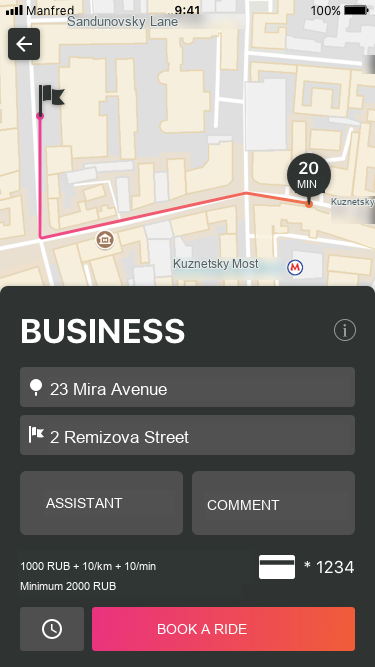
Book a ride
Select the route and request a car. Adapted from the supplied MANFRED screen map.
02 / English-localized screen
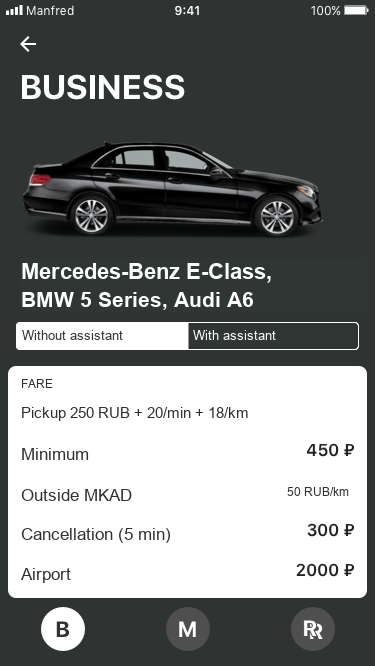
Choose a vehicle
Vehicle category, assistant options and fare information. Figures are preserved from the original design, not current prices.
03 / English-localized screen
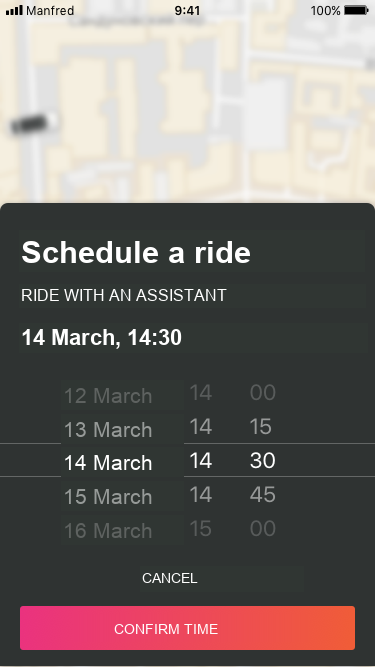
Schedule a ride
Choose a date and time for a future ride.
04 / English-localized screen
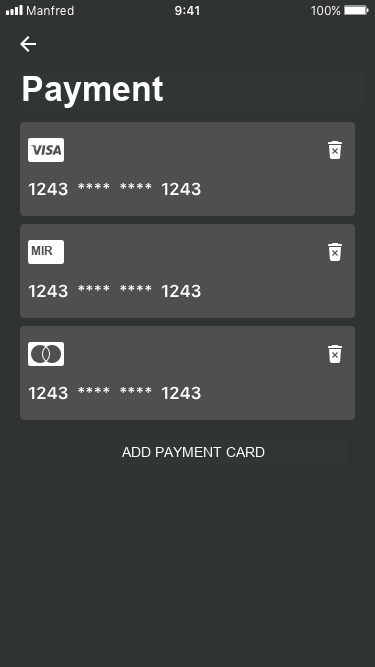
Manage payment methods
Review saved payment methods and add a card. Original masked example values are preserved.
Planning a taxi or mobility platform?
Let’s connect passengers, drivers and service operations through mobile and backend development.